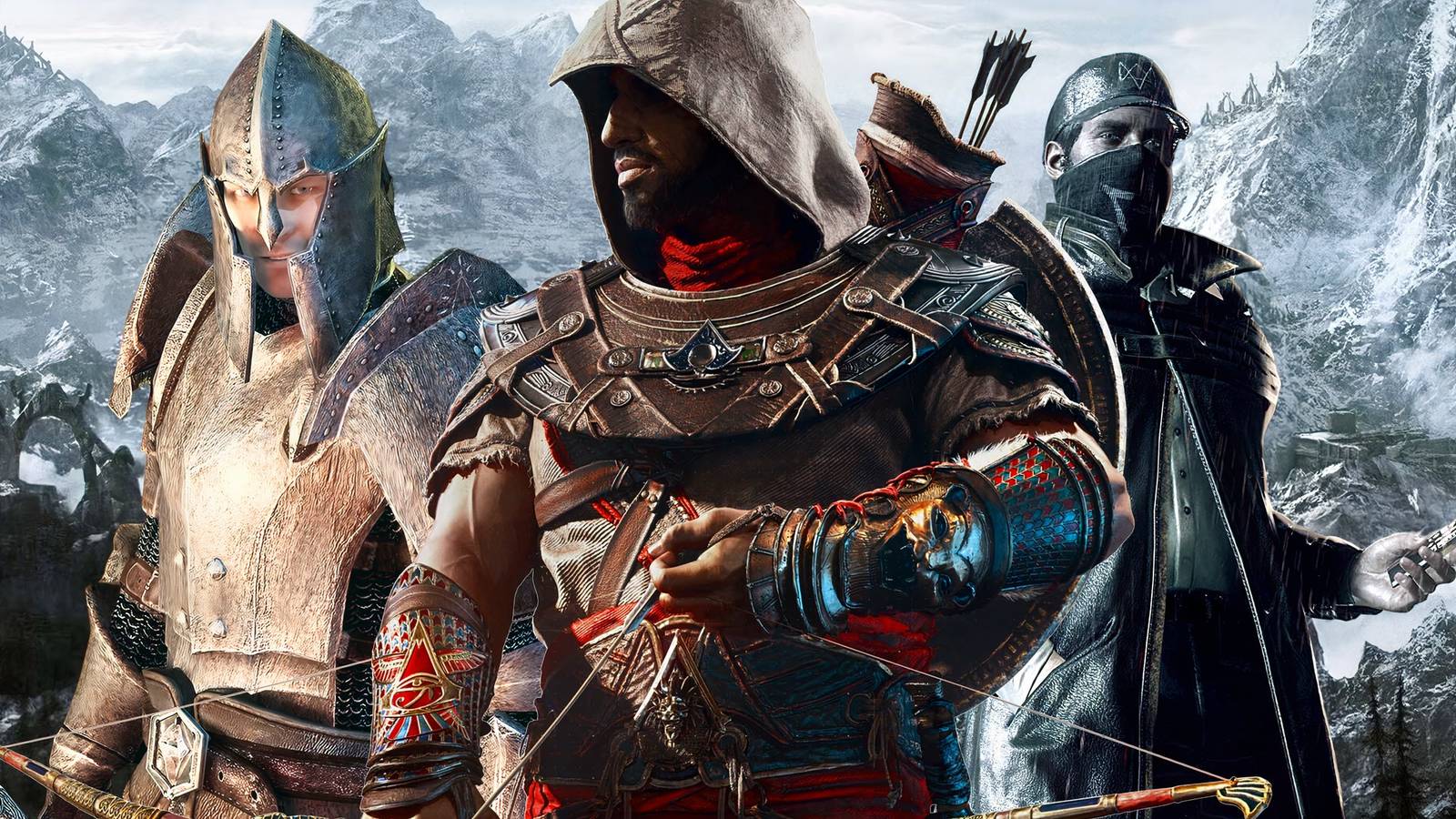
Open-world games are known for being quite immersive, tempting players to explore them to the fullest at the behest of their main stories. However, true enthusiasts of the genre know that a vast world and the number of things to do in it are just half of the hallmarks of a “great” open-world experience. In truth, the other half of what makes an open world fun to be in would be the NPCs that make up the majority of its population.

8 Most Open RPGs Of All Time
Open-world RPGs are one of the most popular genres in modern gaming, and these games take the concept of “open exploration” very seriously.
Open worlds often get called out by players for having boring NPCs with generic routines, breaking the player’s immersion by being reactive instead of actual participants in the world they are in. It’s for this reason that outliers – worlds with unique approaches to NPCs – stand out even more in the genre. However, among worlds with NPCs that try to be “alive,” there are just games to beat in the NPC department – especially with how “smart” they’ve made these “virtual civilians” become.
Watch Dogs: Legion
NPCs Are “Quantum” Unless Interacted With
After DedSec was accused of bombing key locations in London, Watch Dogs: Legion takes the fight for freedom to the streets. This time, DedSec itself is the protagonist, and “anyone” can be a part of the revolution. Players can recruit (and play as) virtually any NPC as long as they were Deep Profiled and have a recruitment mission (side quest) completed. When Deep Profiled and as an inactive agent, this NPC follows a set routine – whether this is work, meeting family, or interacting with others is up to the game.
Until players interact with them, these NPCs are “quantum” by nature. According to an interview, there’s an internal “Census” database that grants these characters vague schedules, jobs, and relationships that ensure they have some semblance of autonomy. This is why some NPCs get chased by the authorities or start fights with other NPCs, and why some NPCs also react violently towards these changes.
Red Dead Redemption 2
NPCs With Routines Authentic For The Time Period
The main plot of Red Dead Redemption 2 puts players in control of Arthur Morgan, a member of the Van der Linde gang, as he and his outlaw friends decide to get enough money to retire. Arthur’s journey is riddled with many anecdotes, most of which are courtesy of NPCs who seem to be capable of adjusting each other’s pre-programmed routines on the fly.
Gamers praise Red Dead Redemption 2 for observably “advanced” NPC behaviors, as their routines are easily disrupted even outside player actions. This is especially true when NPC actions are interrupted, as they may engage each other in fights, and likewise react appropriately to violence in the area (report to the authorities or run away, for instance). It’s as though NPCs in RDR2 follow a “sense-think-act” cycle of assessing changes in the environment, having a reaction, and recalling any previous incidents that might modify this reaction.
STALKER: Shadow Of Chernobyl
The A-Life System Makes Everyone Affect Everything Else
Among games in the STALKER franchise, it’s the original Shadow of Chernobyl that determined the “mystical” tone of its Chornobyl exclusion zone. Set during a disaster that rendered its repopulation efforts moot, the Zone has instead attracted hunters to hunt powerful artifacts. Among them is the player, an amnesiac whose only memory is the tattoo “STALKER” on his arm. Perhaps more interesting is the player’s effect in the environment: any step taken by the player might activate the game’s “A-Life System” and cascade effects throughout the Zone.
Unlike other games with routine-based NPCs, STALKER’s A-Life uses a detailed graph to dictate NPC combat, movement, and even motivations (clearing mutant lairs, finding artifacts, etc.) outside rendering zones. This means STALKER NPCs can wander, hunt, fight, or even die across the Zone – regardless of whether the player is even in the vicinity to witness it. The impact of these events cascades across the Zones, as NPCs from factions may suddenly fight over territory players haven’t visited, traders might adjust prices, and no NPC will have the same actions in any playthrough.
A Vast Improvement To The Radiant AI System
It’s almost become a running gag at this point that Skyrim has a number of special editions that start with the same premise: the player is the Dragonborn who determines the fate of Tamriel, specifically with the return of Alduin, the World Eater. However, beyond its litter of special editions, Skyrim remains praised for its improvement of Oblivion’s Radiant AI. While also used in other Bethesda titles, it’s the Skyrim take on NPC routines and NPC-to-NPC interactions that make each playthrough of the Dragonborn’s journey worthwhile.

7 Best Open-World RPGs With Base-Building, Ranked
Settle down into your new home in these open-world RPGs that come packaged with their own base-building system.
Skyrim’s take on Radiant AI makes better use of its action “packages” so NPCs can make more realistic measures to fulfill goals such as finding food for sustenance, as well as reacting dynamically to situations with others. Skyrim NPCs also have an internal Responsible stat that determines how “moral” they are – say, if they will steal food or try to buy it. These changes make Skyrim’s iteration of Radiant AI radically different from its introduction in Oblivion.
Kingdom Come: Deliverance
Even NPCs Are On Hard Mode Against The Player
When protagonist Henry sees his village ransacked by mercenaries, Kingdom Come: Deliverance will see him join Lord Radzig Kobyla and his resistance movement against Sigismund of Hungary. Being a mere commoner, Henry will have to learn swordsmanship and other skills from scratch – something the game painfully makes players experience, and hence its praise for its realistic tendencies. Even the franchise’s take on AI is rooted in realism, as one of Kingdom Come Deliverance’s developers – Robert Zubek – actually came up with their “Needs-Based AI” based on their theses.
At its core, KCD wanted to get away from “faking life” with generic routines and instead root NPCs with consistent goals achievable through a “network” that manages their relationships and actions. That way, they can react to emergent situations without breaking immersion. As a result, NPCs in the game are designed to be “smart,” in that they are to enforce the game’s rules – like reporting crimes – as best they can. Likewise, actions that interrupt an NPC’s routine may provoke a persistent negative reaction.

Find all 10 pairs
Find all 10 pairs
The Witcher 3: Wild Hunt
A Breathing Fantasy World Perfect For A Travelling Monster Hunter
When Ciri disappears as she’s on the run from the Wild Hunt, Geralt of Rivia pursues the clues she left in The Witcher 3: Wild Hunt. As Geralt’s adventures take him across the world, so too do they insert him into the lives of the game’s many NPCs. The open-world game is known by many to be atmospheric and immersive, thanks in part to NPCs who simulate a “living” medieval world with grounded routines.
These NPCs often follow a schedule: early waking hours, some form of livelihood in the day, visiting town in the afternoon, and returning home for supper. However, they also react dynamically to the environment, such as taking shelter when it rains or staying in at night to avoid danger. It’s implied that part of the NPC’s programming is to interact with others if it helps achieve a goal, as some NPCs are also seen bargaining with others.
Assassin’s Creed Origins
Perhaps The Most In-Depth Look Of The People Ancient Egypt
Assassin’s Creed titles have long been known for their historical accuracy, and the level of detail in Assassin’s Creed Origins transforms Ancient Egypt from the stuff of myth into something tangible for players to interact with. Thanks to Bayek of Siwa, players explore the vastness of Egypt for the first time – making it the perfect backdrop for the game’s plot that finally explains the origins of the Assassin Order. Beyond the awe-striking presence of the Great Pyramids, players can also encounter NPCs with what seems to be fully systemic 24-hour schedules that work even without their interference.

The Biggest Open World Games, Based On The Size Of Their Maps
Open-world games are beloved for their massive maps. Here are some of the biggest open worlds that gamers can explore in the genre.
NPCs in Origins take full advantage of the day-night cycle, with many choosing to work during the day and staying in at night. In fact, some guards elect to sleep in camps when it’s very late, while others fight with rival factions where appropriate. Animals also react to their environment, as predators hunt when prey are nearby, while others are seen eating corpses.
The Chaotic First Iteration Of Radiant AI
Among The Elder Scrolls games, The Elder Scrolls 4: Oblivion became a franchise game-changer for its massive graphical upgrade. Coming from Morrowind‘s rather blocky take on structures and NPCs, Oblivion was a sight to behold. As players finish the tutorial, they will realize Oblivion is known for two things: that amazing view of Cyrodiil when they get out of prison, and that the game’s NPCs can get crazy. This doesn’t happen all the time, but this is thanks in part to the game being the first to use the Radiant AI System.
While somewhat honed in future BethSoft titles, the first implementation of Radiant AI was recognizably glitchy but also deemed an effective way out of the “basic” NPCs in past titles. This first iteration of Radiant AI already paved the way for individual AI packages that contained not just set schedules but also “commands” that are executed based on conditions, as well as preferred locations and any relevant targets. These also have different effects based on an NPC’s hidden attributes. As such, an NPC statted to be morally questionable may kill their way to acquire a specific item, assuming it’s part of their pre-set needs.
Shenmue 2
NPCs Felt Intricate Where Necessary
For a 2001 title, Shenmue 2 remains a classic for fans of old-school titles, especially as it became one of the earliest takes on a detailed open-world concept. As protagonist Ryo Hazuki traverses Hong Kong to find his father’s killer, the 1987 environment comes complete with day-and-night cycles and a weather system. For a game of its time, players appreciate Shenmue 2 not just for its immersive and detailed world but also for the NPCs that come along with it.
Granted, many of the game’s NPCs have copy-pasted routines, but even they are pre-programmed to respond to date and time. Such predefined dynamic actions include acting differently on holidays, or even in response to the weather, like sheltering from the rain. However, the game is also praised for having its fair share of NPCs with more dynamic routines, such as shopkeepers pulling down shutters in the evening or characters visiting specific locations, adding to the immersion.
Saints Row 2
Some Of The Most Chaotic NPCs Out There
For a game made in 2008, Saints Row 2 remains memorable for players who want a wilder variant of Grand Theft Auto – this time set in the crime-ridden-turned-utopia Stilwater, as their character wakes up to find their gang, the 3rd Street Saints, has been disbanded and their territory divided among new gangs. Compared to other open-world titles, Saints Row 2 is infamous for its shenanigans even in the most boring of sessions – something that could be credited with its very random-esque NPC system.
Unlike its successors, Saints Row 2 NPCs seem to be predisposed to being easy to provoke – even by fellow NPCs. Some pedestrians have been observed to attack police and gang members, and leading a gang to another gang’s hideout can start a shootout that can evolve quickly into a three-way when police inevitably arrive.

8 Best Open-World Games You Can Get Lost In, Ranked
For those looking to completely immerse themselves in an open-world experience, here are some of the best games to get lost in.
