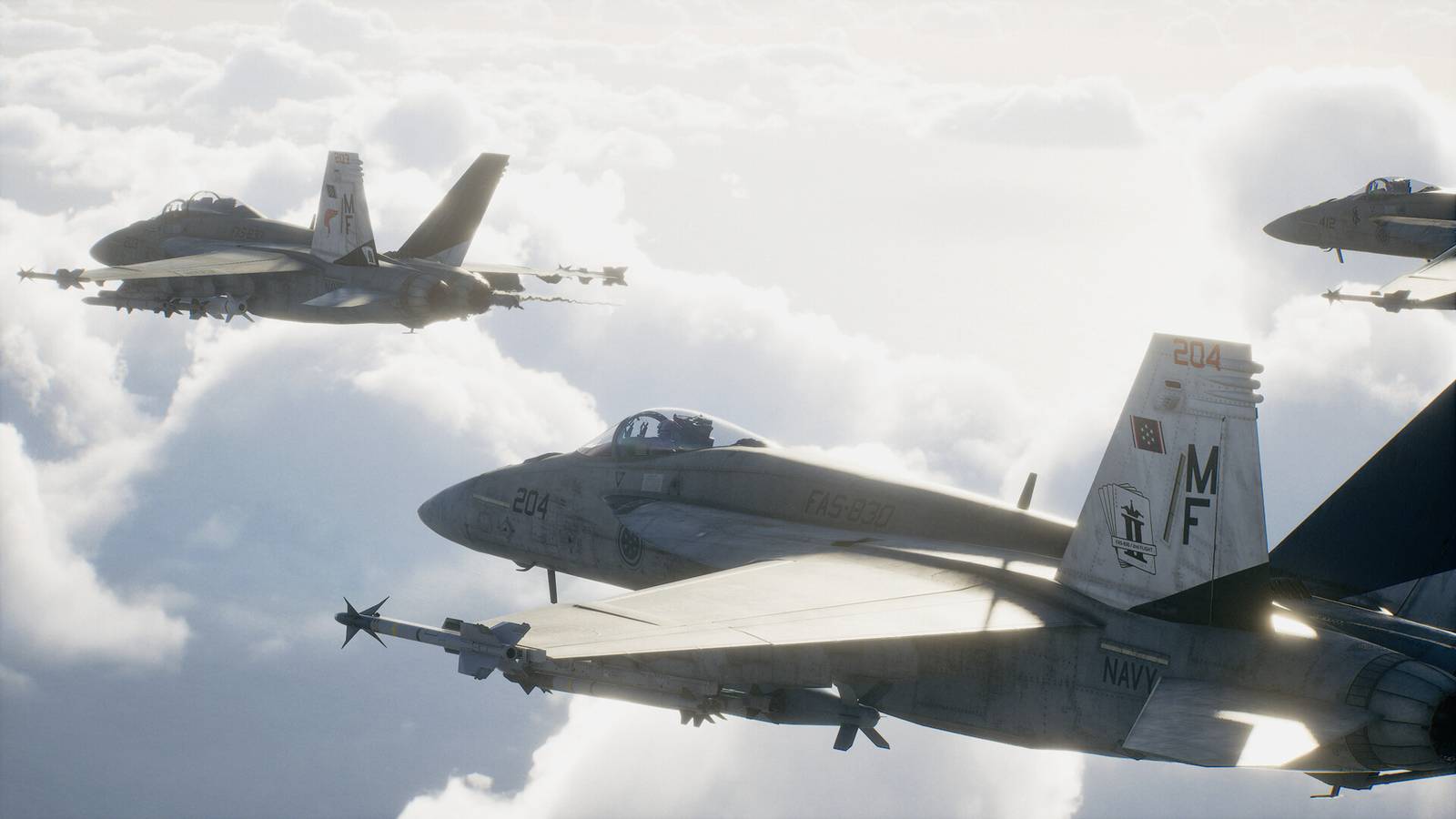
If you are just starting to explore Ace Combat or, if you're really thinking about trying it for the first time, you're probably not alone. Despite the fact that the series started over three decades ago, many players first jumped on board only seven years ago when Ace Combat 7: Skies UnknownThe multi-platform launch allowed it to reach a wider audience – and it certainly helped that it appeared with a lower barrier to entry than previous installments. According to Bandai Namco's official statement, Ace Combat 7 managed to reach 7.5 million players worldwide, making it the biggest launch in the history of the series. Now, Ace Combat 8: Wings of Theve looks set to capitalize on this larger fan base with an even bigger, more accessible and immersive arcade flight combat experience than its predecessor.
But even though Ace Combat is more popular now than ever, the fact that it took the series nearly 30 years to get there begs the question of why. Before Ace Combat 7the series was by no means a failure, and the number 7 in the title is proof enough of that. However, compared to other action franchises, it was quite a niche, despite having a loyal following of dedicated gamers. Well, during the recent one Ace Combat 8: Wings of Theve first look at the event at Orbital Studios in Los Angeles, brand director Kazutoki Kono had some insight into why the series took so long to hit the mainstream, and what he claimed were “three misconceptions” that the uninitiated often have about it.
Misconception #1: Ace Combat is a flight simulator
When I asked Kon about what he thinks are the most common misunderstandings people have Ace Combatit was coming from the perspective of someone whose first experience with one of the games was in reality Ace Combat 7 in 2019. I am fully aware of the misconceptions I had about it before I actually laid my hands on the sticks, and based on the reviews I read and followed that eventually convinced me to get it, my misconceptions clearly matched the opinions of many others. But I wanted to hear directly from Kon what the feedback was from the players on the Bandai Namco side because I felt it would give me a better understanding of why Ace Combat 8: Wings of Theve he seemingly went even further to extend his reach beyond what his predecessor was able to achieve. Kono stated:
The first one is, at first glance, it looks like a flight simulator, and players often think, “Oh, the controls have to be so fine and detailed that it's going to be really hard, so I'm just not going to take it.” But when they really pick it up, it feels more like an arcade shooter that you can dive into very easily.
The first misconception he mentioned was correct for me about money. Before Ace Combat 7I assumed the series was just a collection of flight simulation games and never really cared about the concept. I understand why some people are, but it just doesn't give me the kind of rewarding gaming experience I'm after. However, when I played Ace Combat 7 the first time, it didn't take me long at all to be captivated by its arcade approach to aerial combat. It gave me the fantasy of being an ace pilot without asking me to understand the true intricacies of actually flying a fighter, and that difference is probably the biggest reason the series managed to keep me engaged. Ace Combat it looks a lot scarier from the outside than it actually feels when the player is in control, and in my hands-on time, that's exactly the kind of misunderstanding Ace Combat 8: Wings of Theve It seems to be built to appeal even more directly.
Misconception #2: Ace Combat's Eight Entries create a huge obstacle
The second misconception he mentioned is actually one I had never thought about before, at least not the way he framed it. When I was playing Ace Combat 7 first time and I fell in love with it, my first thought was, “How did I just discover this series? How did six episodes go by without realizing what Ace Combat is it really?” Apparently it all had to do with the reality I thought Ace Combat was just a flight simulation game, but Kono still had a different take on why it took players like me so long to get into the cockpit:
The second is the fact that it has the number on it — 8. And when you look at 8, I'm sure you find it very intimidating and a big obstacle. But actually, I'd flip the script and say that this series has lasted eight iterations and is still going strong. It's actually stronger.
Of course, this makes perfect sense. To see it at first glance Ace Combat received eight major installments over the course of three decades, which is a lot for a newcomer, especially considering it's one of the longest-running video game franchises ever created. It's one thing to jump into a series with its second or even third entry, but thinking about walking through the door into its eighth installment is quite another. New players must see the number 8 and assume they have too much catching up to do, so they avoid it at all costs. But when it comes to Kono, a better way to look at it might be to admit that a series that's lasted this long is clearly successful for a reason, and maybe it's time to find out why firsthand.
Misconception #3: Ace Combat is all about dogfighting
The third misconception is one I totally understand, and it's one I had before playing Ace Combat 7. I wasn't the only one thinking Ace Combat was all about dog fighting and unlocking increasingly powerful planes to use in combat, I didn't know it had a story and a whole world for players to discover. sure, Ace Combat stories are known for being strange, often to a fault. Even Ace Combat 7the game that brought the series into the mainstream has narrative beats that are so absurd you'll laugh at them. Still, it's a part Ace Combat's identity, and that's enough to ensure that this isn't just a game about getting in a jet and shooting down enemy planes until the credits roll. As Kono explained:
And the third is, I think, people's perception that the game is almost all about dogfighting and piloting and combat, whereas when you actually play it, there's a lot of human drama and characters and world building and setting. So we tried to focus a little bit more on the drama component in our first and second trailer, because I think when players actually play it, they think, “Oh my god, I didn't know this world had so much depth and so many characters and interactions and so on.”
And as someone who has played before Ace Combat 8: Wings of Theve after nearly six hours, I can confidently say that this is the most story-driven game in the series yet, and much of that comes from a first-person perspective. The upcoming entry is already proving to be a game that players can really immerse themselves in, rather than one that keeps its characters and world at a distance between missions. There are more cutscenes than I expected, but they never felt overwhelming during the preview. Instead, they made it easier for me to understand who I was fighting alongside, what was going on around me, and why the conflict mattered beyond the next objective marker.

That could be it Ace Combat 8'with the biggest advantage when it comes to winning over newcomers. It still looks like an aerial combat game from the outside, and the number 8 in the title may still make some players feel like they're showing up too late. But if Kona's three misconceptions say anything, it's that Ace Combat it was always easier to misunderstand than it should be. Ace Combat 8: Wings of Theve It seems built to fix that from the get-go, giving players a clearer path into its combat, its world, and its story. If Ace Combat 7 opened the door to a much larger audience, Theve's wings looks like a game that could convince even more players to finally give it a go.

- Released
-
October 2, 2026
- ESRB
-
Teen / Blood, Language, Mildly Obscene Themes, Violence, In-Game Purchases, User Interaction
- Developers
-
Bandai Namco Aces
