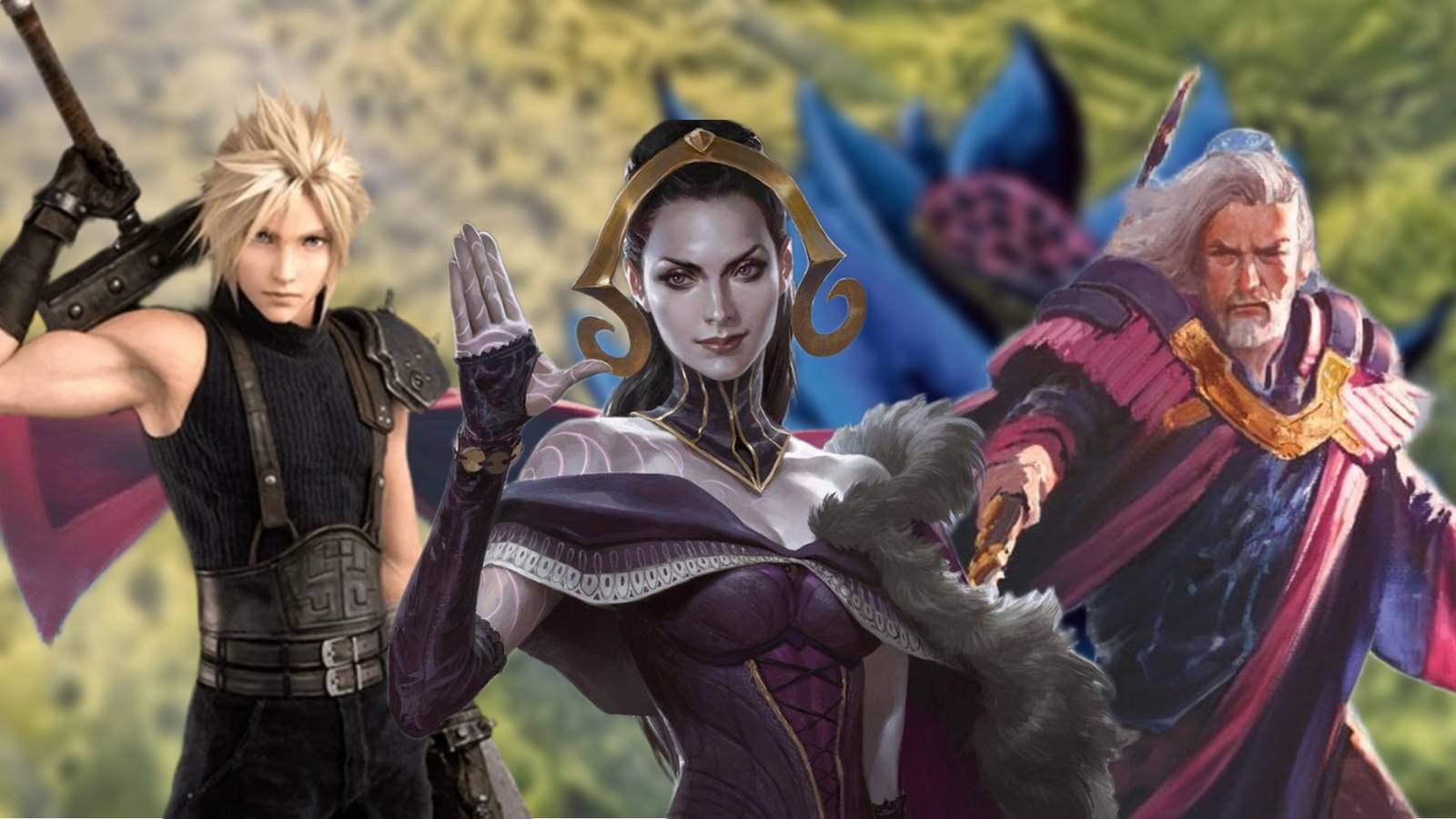
With over 30 years of history to draw from, there are plenty of Magic: The Gathering sets that hold great significance, but there are a select few that stand above the rest. Whether it's for their historical significance, the way they changed the game, or the ripple effect they had on the future of the game, we've identified seven sets that we believe are the most important in MTG history.
We're only going to cover full official sets in this list, so no commander-only releases like Warhammer 40,000, and no releases that were just a few tightly sealed products without full booster packs.
7
Final Fantasy (2025)
A set that solidified the universes further, for better or worse

First, we have the newest entry on this list: Final Fantasy from 2025. No other file on this list will be as recent as this one, but it seems that the impact of this file is already being felt and will be long into the future.
Universes Beyond was originally a concept to be kept out of the standard game. In fact, Mark Rosewater even claimed that UB sets would exist outside of Standard and would only be legal in Eternal formats.
Fast forward to 2024, and it was officially announced that Final Fantasy would be the first Standard-legal Universes Beyond set when it launched in 2025, a decision with a lasting impact that is felt in full force in 2026, when four UB sets will be released for Standard compared to just three original sets.
Whether you love or hate Universes Beyond, you can't ignore the impact it's had on Magic: The Gathering, and while it was a fun gimmick at first, it's now a hard-coded part of MTG's annual calendar, and we have Final Fantasy to thank for that.
What should also be identified is that Final Fantasy is the best-selling MTG set of all time, with two other Universes Beyond products, The Lord of the Rings: Tales of Middle-Earth and Avatar: The Last Airbender in second and third place.
Magic: The Gathering – 10 Best Hero Cards from Marvel Super Heroes
We're ranking the top ten Hero creature cards from the Marvel Super Heroes MTG set so you know who to look out for when building your next deck.
6
Innistrad (2011)
The top-down design and haunted environment worked wonders

Innistrad is the set that defined “Top-Down” design, a term still used today to refer to a set whose flavor and themes were established long before any card names or rules were written.
This design philosophy still holds true today, and you'll often hear designers speak much more freely about how the world influences their design choices than the other way around. It was a limitation that wasn't even recognized as a limitation until Innistrad. The original way Magic was designed was stagnant, and while it was understandably risky to change what had worked for nearly 20 years at the time, it's a risk that paid off massively.
With a top-down design, you can still have the iconic mechanics and gameplay features; they are only added after the set's world and theme have been decided. This new approach to design ensured that certain mechanics were better placed on the cards where they appeared, rather than feeling forced to meet some form of quota.
In addition to the revolutionary set design, Innistrad also introduced Magic to a dark gothic setting for the first time, another risky move that, if it didn't pay off, might have been swept under the rug and never talked about again, but instead is an aspect of the shoot that we still remember and talk about today. In fact, Innistrad sets are among my favorites because of the setting, especially in the likes of Crimson Vow and Midnight Hunt.
Mechanically, double-sided cards were also introduced in the OG Innistrad set and are still used today, albeit with rule modifications based on the set in which they are included. Again, it wouldn't be the same without top-down design. We also have Innistrad to thank for tweaking mechanics like Flashback and strengthening tribal deckbuilding with graveyard interactions.
5
Mirrodin (2003)
The importance of artefacts and dedicated scenography

Next up we have Mirrodin. This set is notorious for several reasons. First, it was artifact intensive and introduced the affinity mechanic that is still used today. This focus on artifacts also heavily influences many formats, including Commander and Modern. Mirrodin was also the first set to include creative input from a dedicated creative department, and while many sets after it refined and improved the world building and storytelling, this is where it all started and became the norm.
Equipment also debuted in Mirrodin, another mechanic that is still active in Magic today across all formats. Imprint and Entwine were other key mechanics from Mirrodin, and they still have a place in Eternal formats even though they were absent from Standard formats.
Modern Magic: The Gathering would be a very different game if it weren't for the release of Mirrodin and probably the entire Mirrodin block, including Darksteel and Fifth Dawn, but it's the lasting impact of OG Mirrodin that lands it on our list.
4
Ravnica: City Of Guilds (2005)
The Guilds debut to balance two-color compositions and shock

Ravnica: City of Guilds is a seismic set for many reasons that Magic players always look back on with nostalgia, especially today. It was released when sets were still being produced in blocks, but more importantly it introduced us to some guilds that we still use over 20 years later.
Boros, Dimir, Selesnya, and Golgari, staples of modern magic, were all introduced in Ravnica: City of Guilds. The remaining guilds would come into play in subsequent sets of Ravnica, but City of Guilds is the first domino to fall in a long line of game-changing moments.
Draft might not be Magic's core format if it weren't for the way City of Guilds improved the format tenfold. Mechanics like Convoke, Transmute, Dredge, and Radiance all debuted, and while not all are still present in their original form, they were major improvements to the game at the time, also tied to a specific guild to offer a sense of identity that can still be felt today.
Shock Lands debuted and found a way to give multicolor decks the land base they needed, but without sacrificing speed and efficiency.
Modern Magic owes so much to Ravnica: City of Guilds, and by extension the entire Ravnica block, including Guildpact and Dissension. Without this set block, I don't think I'd be playing Magic today, and many others are probably in a similar position.
All of this and much more, including the incredible lore, is what makes Ravnica one of the greatest and most important Magic sets of all time, probably my personal number one, but I have to put this penchant aside to look at the bigger picture, and there are undoubtedly some bigger sets to cover.
3
Urza's Saga (1998)
A broken but extremely fun set

Urza's Saga is an important set because it shows what happens when power levels are not managed effectively. This artifact-heavy set is renowned for its overkill and is the bar against which even modern sets are sometimes measured. Endless combos, legendary lands, juiced artifacts, iconic spells, and a well-crafted story will be what Urza's Saga will be remembered for, but it's also a stark reminder to all future Magic sets of what can happen when power gets out of control.
Thanks to Urza's Saga, we've never seen another set release with such a powerful imbalance or such a huge impact on core game formats.
In addition to the power levels, Urza's Saga was also a fantastic stage for complex storytelling. Unlike today, there were no podcasts or live video streams to help explain every single design choice or world-building mechanic, so everything had to come together.
Urza's Saga nailed this aspect of the design, and you can see the set's clear narrative direction following Urza's crusade against the Phyrexians just by taking the artwork and flavor text from the set's 350 cards.
This is something that even modern sets still struggle with, but that's largely because the bar was set so high back in 1998. The comparisons will never end, but it just goes to show the impact this set had at the time of its release that it's still thematically relevant almost 30 years later.
2
Arabian Nights (1993)
The first of many

Arabian Nights made history as the very first expansion for Magic: The Gathering. Ultimately, this set proved that there are ways to expand the Alpha set, but how to do it in a way that isn't just adding more cards to the existing pool. No, Arabian Nights was a themed expansion based on the book One Thousand and One Nights, a collection of Middle Eastern folktales. This book would inspire countless media adaptations featuring Middle Eastern characters such as Aladdin.
This means that the set is inspired and ultimately designed by actual influences, and not set in what would hereafter be known as the Multiverse.
That doesn't matter, though, because all Arabian Nights needed to do was serve as a successful proof of concept that expanding Magic: The Gathering was both possible and worthwhile. It did both with incredible ease.
The legacy of this one obviously boils down to being the first expansion and the original home of the Library of Alexandria, but Arabian Nights did more for Magic than most players today will ever understand. We will never revisit the plain of Rabiah because WotC does not own the intellectual rights to it. Still, it somewhat retains the special status that Arabian Nights has as a set, and while very little remains in game mechanics, the origins of so many modern magical features can be traced back to this set over time.
1
Alpha (1993)
Okay, Duh.

There is nothing more important than the very first set of Magic: The Gathering. The Alpha, sometimes referred to as the Alpha Limited Edition, was released in August 1993 and started what would become a more than 30-year journey to where we are today.
It wasn't perfect, but virtually every aspect of the OG Magic: The Gathering had its charm, and the game is not completely unrecognizable today in 2026. The influences are there, but Alpha is an extremely raw game compared to what we have today.
It's no surprise that the cards in this set are some of the most valuable in existence, including those that made the Power Nine list and OG dual lands.
Looking back, despite its rough looks and occasional glitches, Alpha is a testament to how far good game design can take you. If you understand the basic principles right from the start, even if you make some mistakes and hit the odd obstacle, sooner or later you will end up with gold.
Magic: The Gathering – 7 Most Valuable Lands
There are some pretty expensive lands in Magic: The Gathering that are among the most valuable to play.
