The world of video game consoles is defined by big successes like the Nintendo Switch, the PlayStation 2, and the Xbox 360. These consoles have become household names, but for every console that became famous, many others never made it to stores. They were canceled. These are the ghost consoles, the hardware projects that were too ambitious, too expensive, or simply bad timing.

The Best Looking Game On Every PlayStation Console
We’ve seen some stunning visuals in gaming lately, so here are the games with the best graphics ever seen on every PlayStation console.
These canceled systems are not just drawings on paper. Many were actual, working prototypes. They had unique controllers, special internal chips, and big plans for games. Developing them took years of hard work and large sums of money. Yet, something always stopped them. Maybe the cost to make each unit was too high. Perhaps a competitor launched something better first. Sometimes, the company just ran out of cash.
Infinium Labs Phantom
The Vaporware That Couldn’t Launch

Source: Farbfilm/Flickr
- This console was meant to be the first major system to deliver games through an on-demand subscription service, streaming directly to the box.
- It became famous for its long delays, huge promises, and the company’s financial and legal problems, leading to its collapse before release.
Infinium Labs announced the Phantom in 2003 as a bold idea because it would be a small box that would download and stream PC games on demand instead of using discs or cartridges. The idea was simple and modern-sounding. It would have a huge library, pay-for-play or subscription access, wireless controllers, and a living-room box that lets people play PC-quality games on a TV. That promise won headlines, but the project never turned into a real product for normal buyers.
The company released optimistic dates, but missed them because of financial difficulties. Leadership and legal troubles followed, so over time the company pivoted away from the console idea, sold its assets, and produced only a modest product (a lapboard keyboard) while the console production never really saw the light of day.
Atari Game Brain
Atari’s Cartridge-Based Do-Over

Source: The Laird’s Lair/YouTube
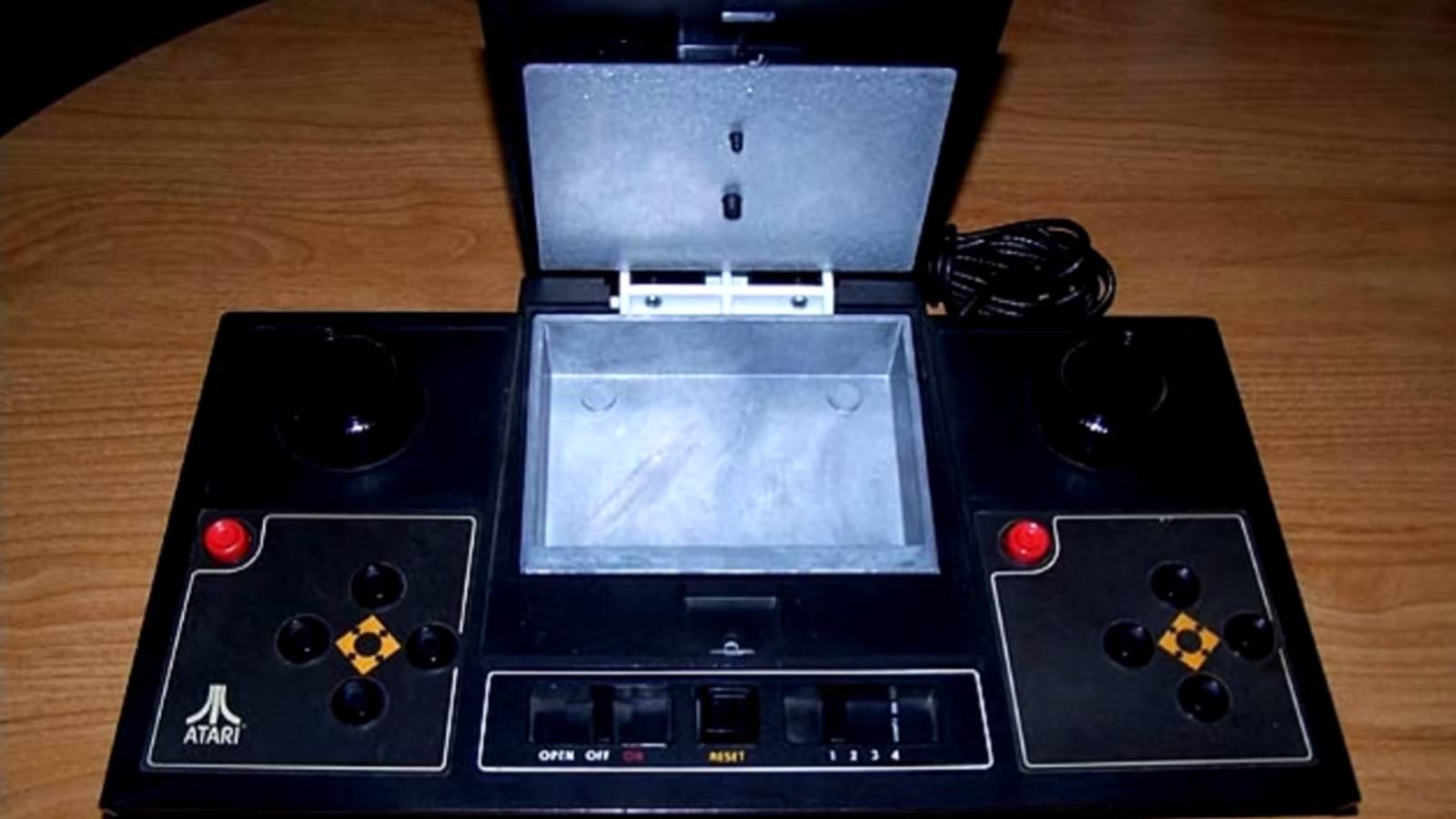
- Planned as a simple console to sell out CPUs from unsold dedicated consoles.
- It was canceled quickly, and focus shifted to the Atari 2600.
The Atari Game Brain was a late-1970s plan by Atari to clear out unsold dedicated-console hardware and sell a low-cost unit that played a small set of built-in games (about 10 games, including Pong and Stunt Cycle) via removable ROM cartridges. The concept was just to reuse existing game code and CPUs to make a cheap device for customers who did not need a full-featured cartridge system.

The Rarest Atari 2600 Games (& How Much They’re Worth)
Collecting classic gaming memorabilia is something of a treasure hunt, especially when it comes to these incredibly rare Atari 2600 games.
Sadly for Atari, the industry was changing fast at the time. Cartridge-based programmable consoles, including the Atari 2600 was growing in popularity because they offered many titles without hardware limits. By the time the Game Brain was ready, the market was moving away from dedicated single-game or fixed-library consoles. Atari quietly canceled the Game Brain and instead dedicated its resources to the Atari 2600.
Sega Pluto
The Saturn’s Secret Upgrade

Source: Adam Koralik/YouTube
- This was an internal prototype that was essentially a Sega Saturn console with a built-in Netlink modem for online play.
- Only about two prototypes were made before the project was shelved.
Sega Pluto was a planned upgrade for the Saturn that would have added a built-in NetLink modem and cost reductions to make the Saturn more internet-ready. The NetLink was Sega’s online accessory for the Saturn; Pluto would have folded that functionality into the console hardware itself. The idea was largely internal as nothing was officially announced by Sega. In fact, it wasn’t until 2013 that the public knew anything about Pluto’s existence. And that was thanks to a former employee leaking the information.
Unlike a full new console, Pluto targeted a narrower goal: lower Saturn production costs and giving online features out of the box. But no production actually happened, and only two known prototypes are known to exist. And they were later auctioned.
Sega Neptune
The Unified Genesis Powerhouse

Source: Long Island Retro Gaming/YouTube
- Designed to be a single machine that combined the Sega Mega Drive and the expensive 32X add-on into one package.
- Canceled because the 32-bit era had already begun, and Sega chose to focus all resources on the upcoming Sega Saturn instead.
Sega Neptune is a caution about timing. Even sensible engineering choices can be canceled if they clash with a company’s larger product roadmap. The idea for the Neptune was to combine the Genesis (Mega Drive) and the 32X add-on into one single, cheaper box. At the time, the 32X was a stopgap expansion to bring 32-bit graphics to Genesis owners, while the Saturn (Sega’s true next-gen console) was already in the pipeline.
Neptune was supposed to be released around 1995, but Sega feared the new combo unit would confuse customers and hurt Saturn sales. The company chose to focus marketing and production on the Saturn rather than introduce another Genesis variant close to the Saturn’s launch window. The Neptune’s prototype stages never translated into retail units; the only surviving evidence is non-functional prototypes.
Konix Multisystem
The UK’s Multi-Talented Challenger

Source: Time Travel TV/YouTube
- Planned to feature a unique steering wheel and flight yoke controller setup.
- The project ran into severe funding issues.
The Konix Multisystem is one of the more imaginative canceled consoles. Designed in Britain in the late 1980s, it began as a high-end joystick/peripheral project and grew into a full console plan. Its standout idea was modular, transformable controls, so the main unit could fit into a dashboard shell with a steering wheel, flight yoke, or motorbike grips. It promised force feedback (a rare feature then), a custom graphics blitter, and floppy-disk storage in addition to cartridges. The Multisystem aimed to be way better than many home computers and consoles of the time, with advanced sound and graphics.
But then, Konix faced manufacturing problems, including hardware issues, and financial strain. The company could not fund mass production, and press coverage grew skeptical as promised launch dates slipped. Although it never shipped, the Multisystem would have been a lot different from traditional consoles.
Atari Jaguar 2
Was Supposed To Be The Original Jaguar Console Upgrade

Source: RedHandsome128
- This was Atari’s attempt to refine and upgrade the original Jaguar console with improved 3D graphics and faster performance.
- The cancellation happened due to Jaguar’s poor sales.
After the original Jaguar underperformed, Atari explored a successor often called Jaguar 2 (or codenamed “Midsummer”). Engineers sketched a new chipset with improved graphics and sound, a faster CPU, and expanded multimedia features like a built-in CD drive. The prototypes required extra cooling and unique power arrangements. The aim was to make Jaguar hardware easier to program and more competitive with mid-90s 32/64-bit machines.

Best Atari Jaguar Games, Ranked
Even though the Atari Jaguar is now just a memory, it’s still worth remembering some of the best games the console witnessed.
The poor sales of the Jaguar meant the company could not justify spending more on a marginal platform. The Jaguar 2 designs were abandoned in 1995, just before Atari teamed up with JTS Corporation, a manufacturer of affordable IDE hard drives for PCs.
Widescreen Gizmondo
The Luxury Handheld’s Second Chance

Source: LGR/YouTube
- A planned second version of the ill-fated Gizmondo handheld, intended to fix the original’s flaws and feature a new widescreen display.
- The project was abandoned after the company’s first launch ended poorly.
The Gizmondo launched in 2005 and quickly became one of the biggest handheld failures in gaming history. Sales were tiny, marketing was confusing, and the company behind it, Tiger Telematics, was hit with financial scandals. Before everything fell apart, the company had big plans for a better model: the Widescreen Gizmondo.
This upgraded version was meant to fix most of the original device’s problems. It had a larger screen, better resolution, a faster processor, and built-in Wi-Fi. The company also talked about adding TV-out and stronger media features so the device could act as both a handheld game system and a portable entertainment device. While the idea looked good on paper, Tiger Telematics collapsed before the new model could enter full production. The company’s debts were huge, and the scandals involving its leadership scared off investors. Once Tiger filed for bankruptcy, all Gizmondo projects were canceled.
Atari Panther
The Pre-Jaguar 32-Bit

Source: ArtistKeyFrame
- An earlier 32-bit console project intended to compete against the Sega Genesis and Super Nintendo, featuring a less complex design than the machine that followed it.
- Atari quickly decided to scrap this system and instead focus all efforts on the more powerful, and ultimately released, Atari Jaguar.
Atari Panther was meant to come out before the Atari Jaguar and act as a strong replacement for the Atari 7800. The plan was to release it around 1991 so it could compete with the Sega Genesis and Super Nintendo. The Panther used a Motorola 68000 processor, plus special graphics and sound chips. One of the chips came from Ensoniq, a well-known audio company at the time. On paper, the Panther was supposed to improve graphics and deliver much better sound than the 8-bit systems most people still owned.

15 Best Games Launched On Atari ST
The Atari ST possessed quite a few memorable games in its repertoire. These are some of the best and most famous of the bunch.
Even though the system looked promising, Atari kept running into problems. The hardware was not easy to finish, and the company felt pressure from the market. Sega and Nintendo were already strong, and the Panther would enter the market late. While the Panther team was still building the early boards, Atari leadership decided to shift focus to a more advanced system. That newer system became the Atari Jaguar.
Panasonic M2
The Expensive CD-ROM Powerhouse

Source: IGDB
- This was a very powerful 64-bit console based on technology originally planned for the 3DO system, designed to handle fast CD-ROM access.
- Canceled because the projected manufacturing costs were too high, which would have made the console too expensive to compete with the Sony PlayStation and Nintendo 64.
Panasonic M2 is probably one of the most advanced canceled consoles of the 90s and one that many gamers still do not know existed. It began as a next-generation console planned to follow the 3DO. It was built around custom chips that were surprisingly advanced for the mid-1990s. There were rumors that the M2 could handle strong 3D graphics for its time, including smooth textures and better lighting than many consoles already on the market.
However, the project ran into delays. Costs kept climbing, and the console market was changing quickly. The PlayStation and Nintendo 64 were gaining attention, and Panasonic began to question whether launching a new system made financial sense, considering the competition around. Instead of releasing the M2 as a consumer game console, Panasonic quietly canceled the retail plan and shifted the technology into other areas.
Red Jade
The Ericsson Handheld That Never Was

Source: IGN
- Was supposed to support 3D graphics, Bluetooth game sharing, and digital downloads.
- Axed due to poor timing and financial issues.
Red Jade is one of those cases where a good idea died not because of bad technology, but because the parent company could not support it anymore. Red Jade was a handheld gaming system funded by Ericsson around 2000–2001. The team behind it wanted to build a portable device that felt more like a small game console than a simple mobile gadget. It was planned to support 3D graphics, game sharing via Bluetooth, and digital downloads at a time when some of the best handheld consoles used cartridges.
But while the hardware looked strong, the timing was terrible. Ericsson was struggling during the early 2000s telecom downturn. Phone sales dropped sharply, and the company had to cut costs across the board. Funding for Red Jade was removed during this restructuring. Once Ericsson pulled out, the entire project had to stop, because it depended fully on Ericsson’s money.

The Best-Looking Game of Every Console Generation
Gaming has come a long way in terms of graphics, but ever generation has had some great-looking titles.
