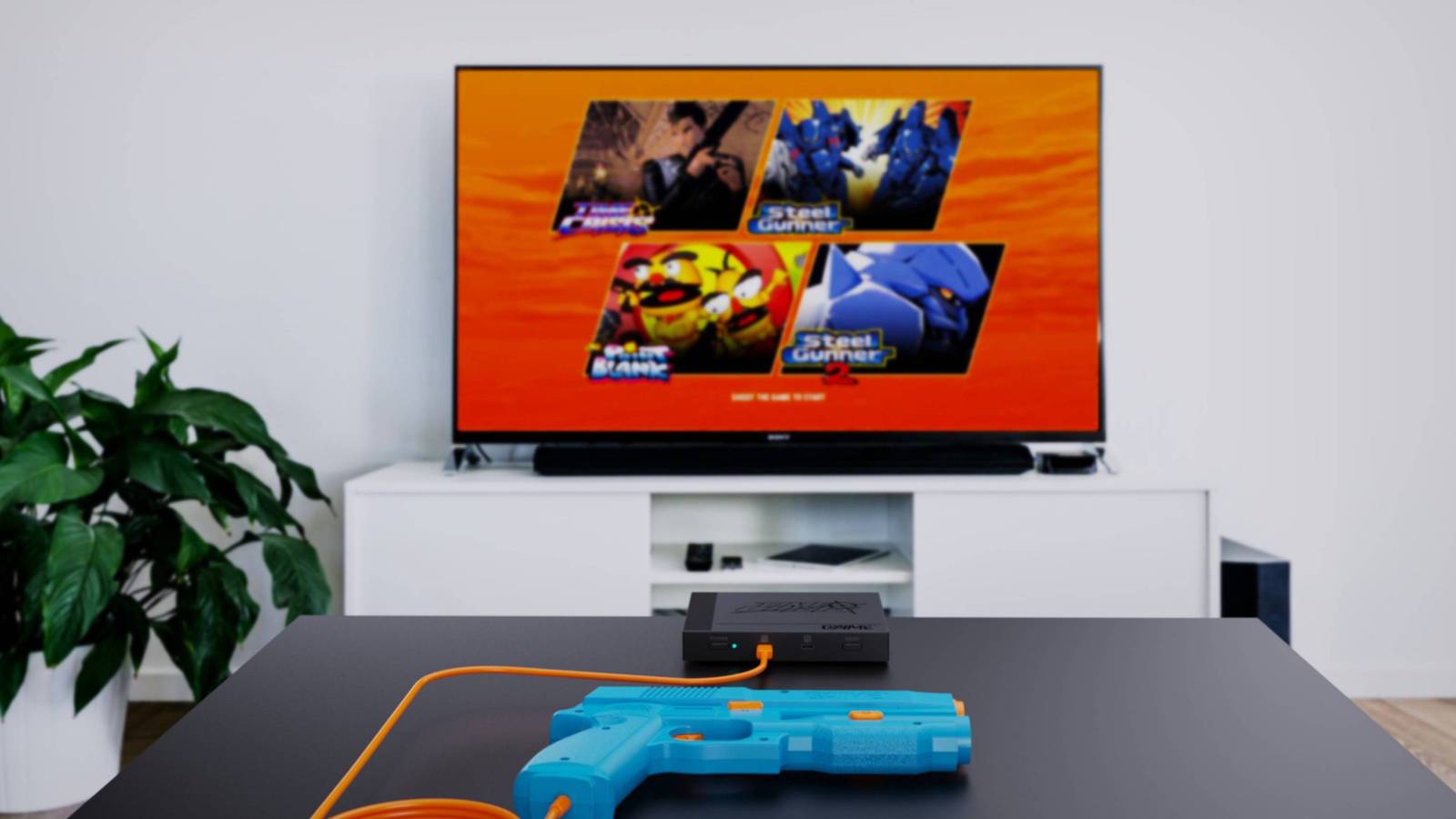
Thanks to backwards compatibility and classic game libraries, we're currently living in a golden age where we can play virtually anything in video game history from the comfort of our own home. The biggest exception is arcade games, which require peripherals to function properly. That's where the G'aim'e comes in, a console that lets you play some of the best light-gun games the old arcades had to offer without ever leaving your house.
While I jumped at the chance to review something that allowed me to play the original Time Crisis the way its developers intended—not just in my home, but on my TV—I was skeptical. I wasn't convinced that it would work that well, and I was even less convinced that the G'aim'e would be able to replicate what it was like to play these games in real life.
Arcade vibes right in your living room

Fortunately, it didn't take long for that skepticism to completely dissipate. G'aim'e not only looks and feels the part, but is just as easy to use as the light-gun arcade games it aims to keep alive. I felt every bit as engrossed in the action of the games it contains as I did standing in front of an arcade cabinet in the mid-90s.
It's also very easy to set up and you don't have to worry about compatibility. G'aim'e is a custom console. All you have to do is plug in the power supply and connect it to your TV using the supplied HDMI cable. When you start the console, a short tutorial video will play, and then you'll have to shoot eight targets on the screen to calibrate your light gun.
You can skip the tutorial the next time you turn on the console, but you'll need to calibrate the weapon each time. It takes about 20 seconds.
Once you do, you'll be thrown right into the action. The options available will depend on the G'aim'e package you choose. If you're only interested in Time Crisis, there's a basic bundle that includes a console, a light weapon, and just one game.

While Time Crisis is undoubtedly the king of the arcade light-gun genre, if you want more from G'aim'e than Time Crisis itself, you'll want either the Premium or Ultimate packs. Each comes with four games to switch between – Time Crisis, Point Blank, Steel Gunner and Steel Gunner 2.
When I first started G'aim'e, my nostalgia meter hit the roof and I saw Time Crisis and Point Blank. Two games that I've spent more time and money on than I care to admit. Being able to play them without having to worry about how many coins I had left was incredibly satisfying and I spent most of my early days with the console jumping between them.
I'm Steel Gunner Guy now

I finally broke away from Time Crisis and Point Blank to check out Steel Gunner. I've never heard of it before, let alone played it. After playing it and its sequels a few times with my son, I wonder where these games have been all my life. I came to G'aim'e for Time Crisis, but I'll stick with Steel Gunner.
I already touched on this, but the biggest advantage and the main difference between playing these games in the arcade and playing on G'aim'e is that you no longer have to worry about where your next quarter is going to come from. You don't need to put a coin into G'aim'e if you want to continue (pretend you did). However, there is a button on the side of your lightsaber to insert a coin, which is a nice addition for those who want to relive the fantasy of wasting pocket money.
It's also incredibly satisfying to tap it and watch the credit number climb.

It also means that even if you've been playing these games for hours in the arcade like me, you'll see more of them played on G'aim'e than ever before. There are parts of Point Blank that I didn't know existed until a few days ago. Did you know that if you complete all 16 stages, there's a fireworks mini-game waiting for you at the end? I also refuse to believe that anyone could get through those Time Crisis boss fights without an endless supply of quarters.
G'aim'e has two-player features, but if you want more than just Time Crisis, it means you have to spend more to access it. The Ultimate Pack, the most expensive option, is the only one that comes with two weapons. You can buy weapons separately if you opt for a cheaper pack and change your mind later. The pedal can also be purchased separately – modeled after the one you press to make it appear in Time Crisis – and is included with everything but the basic package.
There is a button on the gun that replicates the pedal input if you don't have one or it isn't connected.
Four lightsaber games are enough for now

The only real downside to G'aim'e is the limited number of games, even if you buy a bundle that includes all four. Light gun games are short in nature as they were created to be played in arcades. I've played all four multiple times, and while the replay value is much higher than most games, it would have been nice to have even more arcade classics from the golden age of light gun games to choose from, even if they were introduced as add-ons that you had to pay extra for.
That said, even though my review is done here, the G'aim'e isn't going to be something I pack up just to take out and dust off so I can show it off at parties (although I will definitely be showing it off at parties). My son is already gearing up for his fourth game of Steel Gunner 2 and I'm slowly improving what is admittedly still a pretty poor Point Blank skill in many of the minigames. I won't be done with G'aim'e for quite some time, but I also hope this isn't the last we see of this console. It's a very cool idea that far exceeded my expectations, and whether it's through an expansion or a sequel, I'll be first in line if there are more.


- Released
-
October 31, 1997
- ESRB
-
T // Animated violence
- Developers
-
Namco
- Publishers
-
Namco