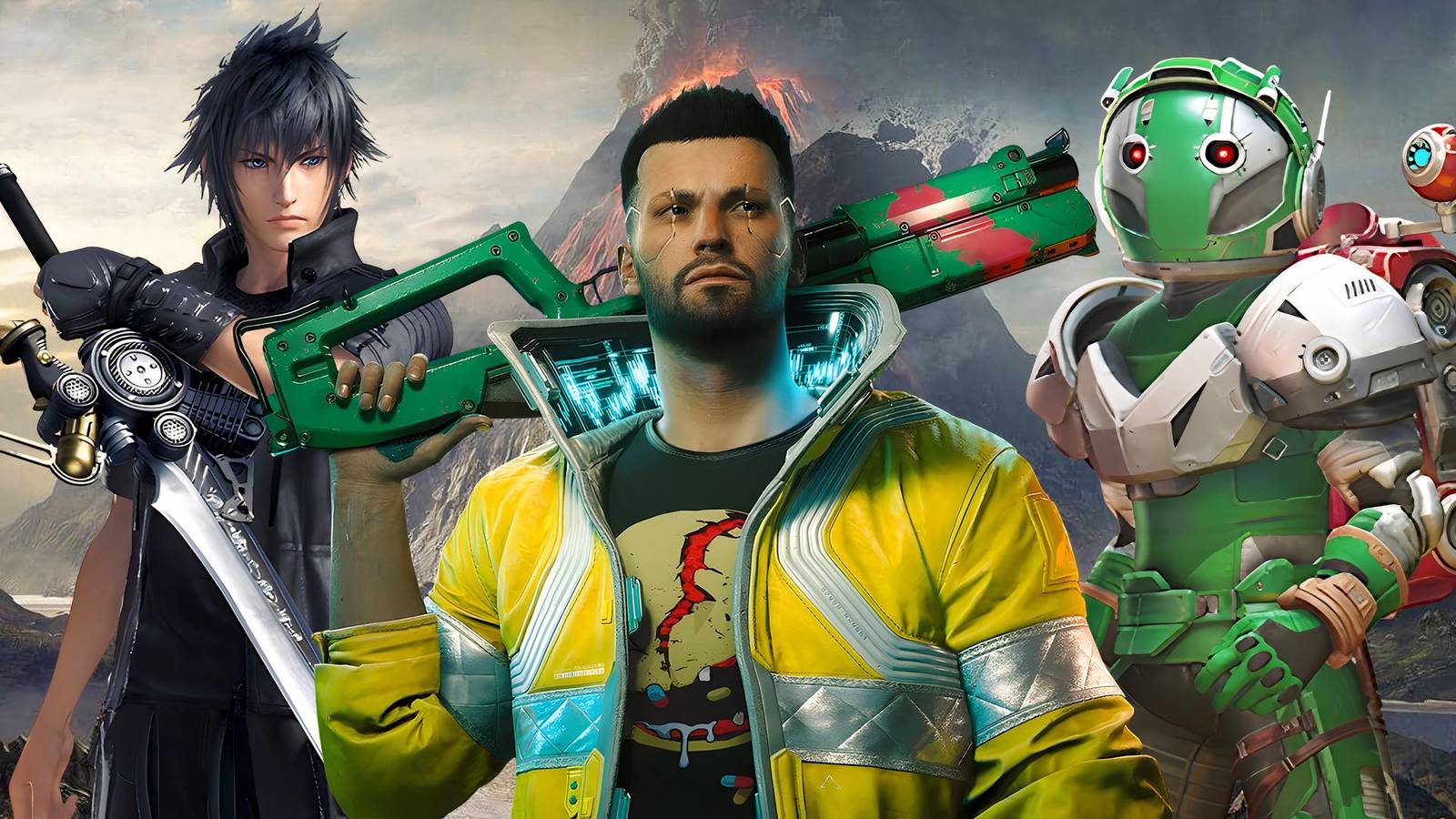
It’s not always the case that a hit game impresses gamers upon release, especially in today’s day and age, where a Day One launch can determine whether or not a game can survive for the long term. Sometimes, an underwhelming launch can destroy a game entirely – but in rare instances, a game can use such a setback as a springboard to get stronger than ever. In those rare situations, a game can rise from the ashes into a force to reckon with – and it’s thanks to these moments of failure that some games actually manage to evolve into something gamers can remember.
Open-World RPGs With The Best World Design
With great design and staggering detail, players will never want to leave these open-world games and their immersive worlds.
Today’s modern gaming scene saw a number of these surprise comebacks, often through unfortunate launches that earned the ire of gamers, and then earning their goodwill through some very radical strategies. Some of these games get their big breaks after a slow build of one good update after the next, while some drop some banger overhauls that finally solved their fans’ biggest criticisms. Just which games showed these the best?
Destiny and Destiny 2
Third Time Is Always The Charm

Destiny



7/10
- Released
-
September 9, 2014
- ESRB
-
T for Teen
-Animated Blood
-Violence
When Bungie of Halo fame got together to make a new sci-fi shooter, 2014’s Destiny resulted in quite the mixed reception. While the rush of its gunplay and dynamic abilities became a trademark in the series, it’s also plagued by a lackluster plot and a weak narrative. It didn’t help that its initial endgame had a large focus on grinding, making Destiny a prime example of a looter shooter. In fact, it took its third expansion, The Taken King, to reinvigorate the game with new multiplayer modes, finally being able to use a sword, and new subclasses to further boost replayability. These all came on top of one of the game’s best story segments so far, finally giving a “pay off” to the build-up in the narrative as players fight Oryx, the Taken King, and the eponymous new faction.
Given the tumultuous first year of Destiny, one would think Bungie would have learned its lessons after launching Destiny 2 in 2017. Turns out, the sequel suffered from the same growing pains of its predecessor: an underwhelming and confusing introductory story, some confusion with the gameplay tweaks, activities that got a bit stale over time, and overall gameplay that took a while to get its groove going. In fact, it wasn’t until around Forsaken (funnily enough, the third expansion) that Destiny 2 managed to capture player interest: an overhauled loot economy, Cayde-6’s death reintroducing stakes, a seasonal model for more frequent releases, and a much tighter and accessible narrative.
Diablo 3
Debuted The Infamous Real-Money Auction House

Diablo 3
7/10
- Released
-
September 3, 2013
The 2023 Diablo 4 release for the PC and major consoles was a welcome sight to ARPG fans, especially when the closest thing prior was 2022’s Diablo Immortal – an underwhelming mobile Diablo-lite, of which 2018’s “out-of-season April Fools joke” criticism became less of a gag and more of an ill omen. However, Diablo Immortal wasn’t the only Diablo game to ever encounter quite a roasting, especially when 2012’s Diablo 3 launch also became infamous for its much more vibrant aesthetic and its always-online DRM. The worst offender? The real-money auction house was originally designed to combat third-party trading, but instead transformed D3 into more of a pay-to-win experience, where the game’s hottest items were easily put up for sale.
Every Diablo Game, Ranked
The long-running Diablo series has had its fair share of highs and lows. Here’s every game in the franchise, ranked.
The decision to axe the Auction House in 2014 was a welcome sight to players, paving the way for the much-requested Loot 2.0 system that implemented smarter drops and class-relevant gear based on whoever is playing at the time. Around the time Diablo 3: Reaper of Souls released with the Crusader Class, so too did the game receive sweeping gameplay changes. Difficulty became more streamlined, monsters scaled properly, Seasons became periodical playthroughs with new rewards, and Adventure Mode’s Bounties and Nephalem Rifts encouraged many ways of playing.

Find all 10 pairs
Find all 10 pairs
Regular Cover ArtClean Cover Art
Final Fantasy 15
Shipped An Incomplete Mess, With A Broken Second Half
The pressure’s already on with the initial launch of Final Fantasy 15, especially when its 2016 release marked the tenth year of the game’s development history. Starting as an action-oriented spinoff named Final Fantasy Versus XIII, Prince Noctis’s adventures in FF15 marked a stark departure from the series formula. The game is set in a fully open world featuring a teleporting Noctis and a three-man entourage acting as the rest of a traditional Final Fantasy party – complete with a gunslinger, mage, and tank. Action prevails in a majority of the game’s fight scenes, all scattered across a story of Prince Noctis reclaiming his throne, masked as a countryside road trip.
However, boy band aesthetic aside, Final Fantasy 15 quickly showed its flaws as the game progressed: players can’t switch to other characters except Noctis, the game becomes ridiculously linear by the time they reach the second act, and it came with quite the lackluster ending. Soon, it became apparent that Final Fantasy 15 shipped as an incomplete title. As the game started to make fans question the future of the franchise, Square Enix doubled down on fixing FF15 – starting with a rework of the controversial Chapter 13 that resolved a lot of unfinished character arcs. DLCs for the game finally expanded the story of each of Noctis’s companions, and they even released a much-awaited co-op mode. Buying 2018’s Royal Edition compiles these improvements.
Felt Very Generic, Unforgiving Compared To Its Standalone Counterparts
When The Elder Scrolls Online launched as a series prequel in 2014, this time with players as the Vestige, a resurrected adventurer central to Molag Bal’s current (in the lore, former) attempt at conquering the world. It came with all the trappings of an Elder Scrolls game – a fully open world and deep lore hidden within books and quests. Unfortunately, the similarities of The Elder Scrolls Online with other Elder Scrolls titles ended there, as the MMO’s initial launch came with janky animations, harsh level-gated locations, and boring quests – very similar to every other MMO in the market out there, a far cry from the depth Elder Scrolls titles often offered, and ridiculously overpriced for a USD 60 game with a paid subscription.
The much-awaited fix finally came in 2016’s “Tamriel Unlimited” update, with an overhaul including the removal of level gates, “free-to-play” seasons with rewards, instant skill resets for replayability, and DLCs that slowly revealed more locations and completely new classes (Warden with 2017’s Morrowind, Necromancer with 2019’s Elsweyr, and Arcanist with 2023’s Necrom Chapters). Most importantly, the 2016 rework came with a “buy now, free forever” offering, making the game accessible as a one-time purchase for franchise veterans and newcomers.
Warframe
Initial Microtransactions, Destiny Comparisons Hurt Its Playerbase
Gamers in 2013 would probably remember looking at Warframe and instantly making the comparison to Bungie’s much-awaited Destiny launch the year after. Seeing how Warframe is made by a smaller dev team compared to Bungie’s, as well as the unfortunate panning of Digital Extremes’s Star Trek tie-in game, and one won’t be surprised why initial players would switch to Destiny. Not to mention, some microtransaction elements, such as extended skill trees, soured the initial impression of an already-dwindling player count, and it didn’t help that Warframe at the time was already struggling to make ends meet with a lack of funding.
However, what Digital Extremes did was very much like their name – and removed microtransactions altogether. Players who wanted to support the game can buy “Founder’s Packs” that contain currency and in-game items – something that kept them barely afloat as the idea of a “free-to-play” title struggled to gain media attention in the early 2010s. This dedication to the F2P concept paid off, as their loyal fanbase (and streamers like TotalBiscuit) promoted the game through word of mouth, and 2015’s Parkour 2.0 overhauled movement to transform Warframe into the fast-paced “ninjas in space” it is known today. By 2019, Warframe had around 50-million registered players and secured itself as a separate entity from Destiny altogether, courtesy of a post-apocalyptic sci-fi mythology.
Cyberpunk 2077
A Broken Launch Redeemed By Slow Refinements
While the first big marketing “push” for Cyberpunk 2077 happened around 2018, its development started as far back as 2012 after the release of The Witcher 2. Given the 8-year wait, there’s tremendous pressure in actually pulling off an RPG with the same mechanical depth and narrative of The Witcher (especially The Witcher 3) while staying faithful to the cyberpunk genre. Unfortunately, its release came more or less as a mixed bag. Players loved its vibrant open world and its deep narrative, but only if they could bear with its mechanics, and especially its plethora of bugs.
Cyberpunk 2077: Every Ending, Ranked
Cyberpunk 2077 features a wide range of potential endings, but which of them is the best and most fulfilling end to the experience?
In fact, such was the “broken” state of Cyberpunk 2077 during its launch that players started refunding the game, while Sony even pulled it from the PlayStation Store. It even came to a point that a class-action suit was filed against CDPR for being unfaithful to investors about the true state of the game. However, the release of the acclaimed Cyberpunk: Edgerunners anime on Netflix started to regenerate hype around the game, with both an Update 2.0 and the Phantom Liberty expansion breathing new life into overall mechanics. Update 2.0 largely fixed a lot of bugs and technical woes players found in the game, while Phantom Liberty provided a plethora of new additions (a new skill tree, quick hacks, vehicle combat, among others) on top of a deep enough story to bring players back to Night City.
No Man’s Sky
Overpromised Everything Except The Aesthetic
When Hello Games revealed No Man’s Sky in 2013, it gave players quite the bold premise: a completely procedural universe, with stars, planets, flora, and fauna built differently for every player. There were even claims of multiplayer and emergent civilizations. This space sandbox comes complete with a vibrant aesthetic reminiscent of 70s and 80s sci-fi – radically different from the monotonous space games of modern times. However, the 2016 launch showed No Man’s Sky as quite the opposite of what it promised.
Essentially, the initial release of No Man’s Sky quickly showed the limitations of its procedurally-generated premise: a finite number of assets meant a finite number of combinations, a rather repetitive exploration premise, and a bleak “open-endedness” that its aesthetic couldn’t save. Despite the turbulent launch, Hello Games brought over the “Foundation” update that started a slow patch-by-patch overhaul of the game. “Foundation” brought over user bases and new gameplay modes, “Pathfinder” (2017) made planet exploration easier, 2018 through 2024 brought in multiplayer, more activities, and better procedural generation, all the way to 2026’s “Xeno Arena” that added a full-blown creature capture and battle to the game.
Final Fantasy 14
A Launch So Bad Square Enix Had To Nuke The Game
Despite being in development since 2005, the dismal 2010 launch of Final Fantasy 14 earned the universal ire of its fanbase. On top of servers being unable to handle the load, the game is nowhere near optimized for a largely PC-centric MMO playerbase. Its overall UI and UX – from controls to skills, inventory, and looting – are abysmally complex to get through, while its leveling is locked in limited and timed quests. Other oddities include instances of invisible walls, items with durability scores but having no indicator, no in-game database, damage-based XP gains discouraging casters and healers, no auction house, and no hardware mouse support. What made all of these even more rage-inducing for fans is that Square released this as a subscription-based title.
It came to a point that Square Enix actually issued a formal apology to players and began a complete overhaul, aptly named “Version 2.0.” The interim came with a much-needed Patch 1.18 that overhauled the combat system and a new story that overtook the original one, eventually building up to the “End of an Era” trailer for A Realm Reborn that coincided with the shutdown of the servers, which involved actually destroying the current world in the story and sending the players five years into the future. Since then, Final Fantasy 14 became one of the most acclaimed MMOs at the time with a compelling narrative, an intuitive control scheme, and dynamic combat and class mechanics.
Upcoming Role-Playing Games People Are Excited For
While plenty of RPGs have been announced for 2026 and beyond, these upcoming role-playing games are especially exciting.
