All available evidence it suggests Assassin's Creed Hex will take place during the German witch trials in Würzburga particularly bloody crusade that developed in the early 17th century. Assuming this is the case, Assassin's Creed Hex can be expected to be an unusually dark and grim entry in a series whose historical background is characterized by immense, indiscriminate brutality.
The history of Würzburg paints a disturbing picture of religious hysteria and autocratic, state-sanctioned murder. Like many of the witch trials that took place throughout Europe and the United States in the 17th century, the Würzburg Trials of 1625-1631 are generally attributed to the struggle between the Catholic Church and the Lutheran and Protestant Reformations. With the loosening of Catholicism's grip, accusations of heresy and blasphemy were backed up by interrogations, torture, imprisonment and, in the case of around 900 Germans in the Wurzburg region, death. What distinguished the Wurzburg from other witch trials of its era was its indiscriminate nature, as men, women and children of all classes and demographics were tried without remorse. That might inform AC Hex's story in many ways, but especially when it comes to its cast of historical figures.

Assassin's Creed Hex is getting an exciting and invigorating update
After first being teased in 2022, a trusted industry insider gives Assassin's Creed fans an exciting and invigorating Codename Hex update.
Prince Bishop Julius Echter von Mespelbrunn
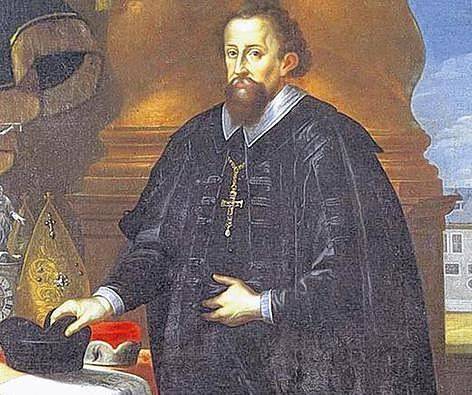
Although he did not oversee the Würzburg witch trials that began in 1625, Prince Bishop Julius Echter von Mespelbrunn played an important role in the prelude. Echter was appointed to the office of Prince-Bishop of Wurzbug in 1573 and, thanks to his role as civil ruler and representative of the Church, took a hard anti-reformation stance. To this end, he expelled the Lutherans from the Prince-Bishopric of Wurzburg and reestablished the University of Wurzburg as a Catholic educational center.
Scratch & Peek

Identify the cover and scrape off as little of the foil as possible.
Start
Identify the cover and scrape off as little of the foil as possible.
EasyMediumHardPermadeath
Broadly speaking, Echter's reign resulted in a greater conversion to Catholicism, with an estimated 100,000 Reformed Christians returning to the Vatican-sanctioned sect during his tenure. He even presided over relatively minor witch trials, which of course included executions, setting the bar for an “acceptable” level of violent prejudice against non-Catholics. These trials are said to have slowed down around 1617, probably due to Echter's death and the coming Thirty Years' War, but his nephew Philipp Adolf von Ehrenberg escalated his designs a few years later, sparking the witch trials that Assassin's Creed Hex will reportedly focus on
Prince Bishop Philipp Adolf von Ehrenberg

Appointed Prince-Bishop of Wurzburg in 1624, Philipp Adolf von Ehrenberg was as radical as his uncle and predecessor, if not more so. His mission, perhaps encouraged by the growing tensions between Catholics, Protestants and Lutherans as a result of the ongoing Thirty Years' War, was to create a uniformly Catholic region. This included the sending of a special commission to deal with reports of witchcraft, which led to an ever-growing list of those accused.
It is impossible to be certain, but many historians believe that the extensive nature of the Würzburg trials was a result of the illegal torture methods used by Adolf's witch-hunting commission. During the torture, those accused of witchcraft were called upon to name their accomplices, and as is often the case with torture, they quickly spilled the names in hopes of forgiveness, or even release. This practice, coupled with the greater paranoia and hysteria characteristic of Reformation-era Europe, essentially meant that no one was safe from the wrath of witch hunters.
Ernst von Ehrenberg

As already mentioned, the Würzburg trials were unique in their relative absence of discrimination; many elite members of society, most of whom would otherwise have been virtually immune from criminal conviction, were quickly arrested, tried, and executed on charges of witchcraft during this time. Typical of this unconventional scenario is the case of Ernst von Ehrenberg, Adolf von Ehrenberg's own nephew, who was found guilty of witchcraft, beheaded and his body burned.
While Ernst was not particularly influential during the Würzburg trials, his situation is certainly interesting. Assassin's Creed Hex could meaningfully explore. After all, we're all probably used to stories in which nepotism and rank protect evildoers from justice. It is not typical to see stories where the polar opposite takes place.
Place 9 games in the grid.
Start
Place 9 games in the grid.
Johannes Junius

While Johannes Junius was not tried in Wurzburg, he was arrested and executed for witchcraft during the concurrent Bamber trials. Shockingly, Junius was actually the mayor of Bamberg and confessed to some bizarre and disturbing acts, including sacrificing a horse to Satan and attending witches' sabbaths on the back of a flying dog. However, he is said to have initially denied all charges and confessed only after weeks of horrific torture, which he highlighted in a letter to his daughter Veronica, characterizing his confession as the result of coercion. He was executed in 1628.
Again, I wouldn't expect Johannes Junius to be particularly impressive in this regard Assassin's Creed Hex's plot, but its heartbreaking story is emblematic of the era's larger issues. In his letter, he outlines in clear and intimate language the methods German witch hunters used to get their victims to confess, and his case serves as a particularly visible and well-documented example of the horrors the church was conducting at this time.
Friedrich Spee

Here we have another whistleblower from the 17th century witch trials, but on the other side of the pulpit. Friedrich Spee was the confessor of witches in Wurzburg and thus played a vital role in hundreds of witch arrests. But Spee put on a brave face in the later years of the Wurzburg trials when he wrote in his book Cautio Criminalis that he did not believe any of the executions he oversaw were fair. Spee seemed to believe, as do many historians today, that virtually all confessions obtained through torture are worthless and that the Würzburg trials were largely misguided.
Spee's hair is said to have suddenly turned white as a result of his experiences during Wurzburg, which, while somewhat unrealistic, could in a video game such as Assassin's Creed Hex.
Maybe Spee could be one of the player character's allies Assassin's Creed Hexserving as the “man inside” of his species. Spee's inner ethical conflict is ripe for meaningful narrative interrogation, as AC Hex he could follow his change of heart and provide a glimmer of hope for the Catholic Church; Spee is proof that not all who participated in the Wurzburg trials lacked honor and humanity.
