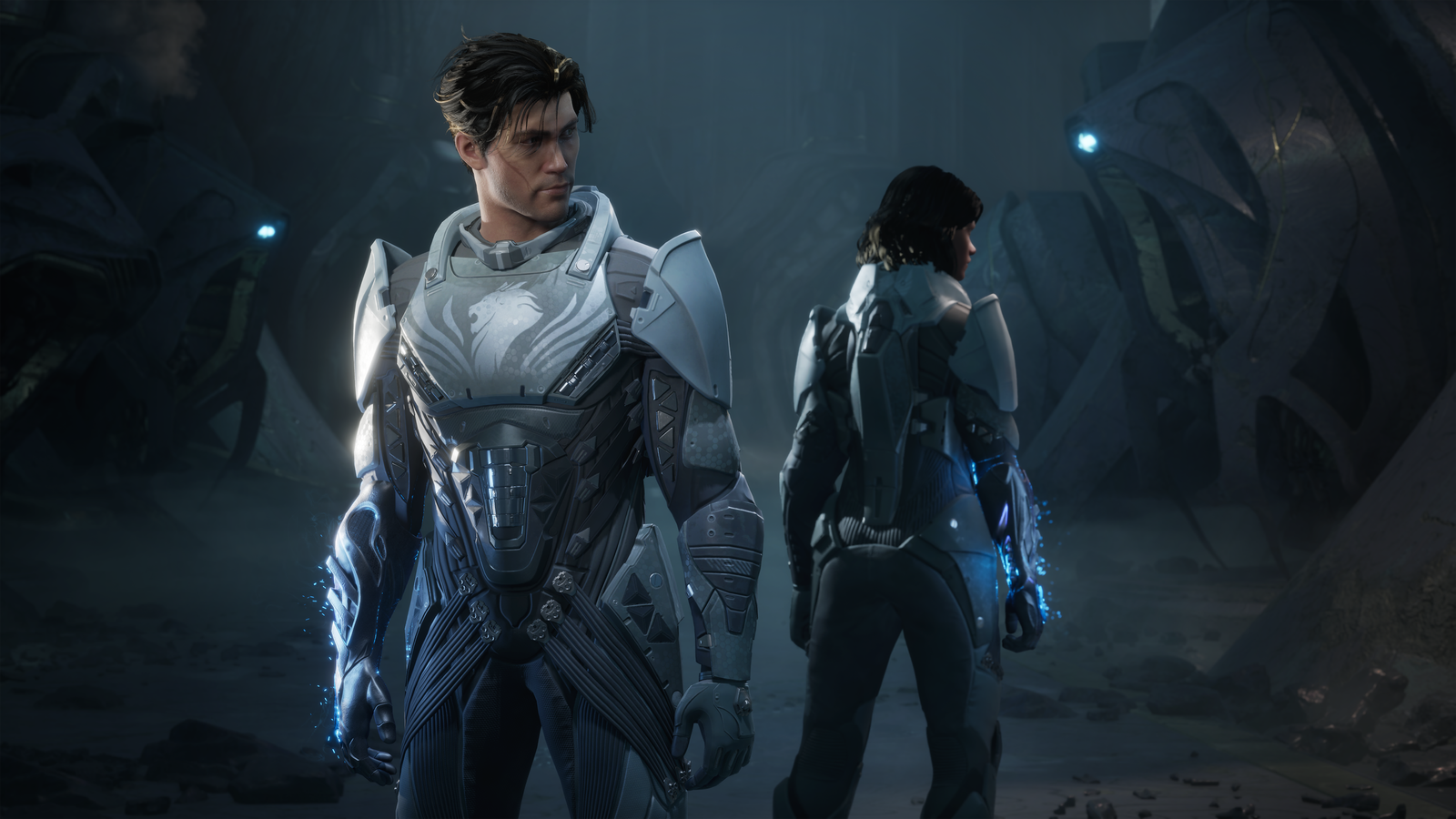
It's been almost ten years since we got a new Mass Effect game. In that time, BioWare as we knew it ended up with massive layoffs, convoluted development – both narratively and technically – on Dragon Age: The Veliguard, and slow progress on the next Mass Effect.
No wonder so many Mass Effect fans threw their weight behind Exodus. This sci-fi RPG is being created by some great ex-BioWare talent, notably James Ohlen (who has since left the studio) and Drew Karpyshyn, who both worked on KOTOR and the original Mass Effect trilogy.
The latest trailer shows how Mass Effect-y Exodus will be, at least in terms of its presentation. We have a group of up to two companions at a time and can bark orders at them during combat. Through skill trees, we gain new abilities for them and ourselves. There's even a Paragon and Renegade system (here, considering the legally different nomenclature of Paladin and Immortal), and you can earn points on both sides by unlocking different abilities.
But of course, Paragon and Renegade were mainly there for roleplaying in Mass Effect, and the Exodus version is no different. In the character creator, you choose whether you're a Paladin or an Immortal, and earn points on either side depending on the choices you make. The developers emphasized that our choice in the character creator won't lock you in right from the start, and they expect some trial and error before players land on either side.
Still, even with that in mind, I fear it still bears the hallmarks of Mass Effect's binary morality. In a conversation, we always saw only two or three basic dialogue options. When faced with a (seemingly) life or death decision for one of our companions, there are only two options. And none of this seems more profound than deciding how violent you want to be.
This life-or-death scenario was presented with much fanfare in the trailer, with the preview ending before we could see the consequences of this decision. It comes down to whether you try to diffuse the situation with violence or words, a conundrum typical of Paragon and Renegade game design.
While it may be too early to judge, it doesn't scream Mass Effect or a KOTOR successor, but a reworking of similar mechanics. A similar scenario in Mass Effect 3 – where you have to talk a former companion into not shooting you – depends on a wide range of factors. How you talk to them is important, but so is how you engage with environmental politics. And unfortunately, the feeling for science and how we communicate with it was somewhat lacking here as well.
Exodus had no way of cramming something like a scene from Mass Effect 3 into a brief look at the first game in this new IP, but I've yet to see the basics of it either. The character moments may be there, but what about the politics? What about ideological conflict? Where, more simply, is the sauce?
How customizable is our character in Exodus?

Another concern revolves around our player character, Jun Aslan. In the preview, the developers were quick to reiterate that Jun could be male or female, but we didn't get a good look at the female model. After that, Jun was referred to as male throughout the presentation.
This is ironically something of a break from Mass Effect tradition, with many hardcore players favoring the Femshep, even though the overall player base still gravitates towards the male variant.
Jun has the story behind the child of a famous man and the heavens; a group of highly developed people. Their older half-brother cheated them out of their inheritance, so they had to go into hiding. When you start the game, Jun is a traveler trying to use ancient celestial technology to save humanity.
Right off the bat, it's a lot more background than the games Exodus draws from. Shepard can even have one of three stories and three different kinds of service history before even touching the Paragon and Renegade system. Couple that with how Dude Jun clearly has a lot more to do than his female counterpart, and he seems to be a lot more of a pre-scripted hero than fans of the old BioWare games would have liked.
A lot of the game could hinge on how much we like Jun as a character rather than how we build our own Jun, and right now I'm not convinced. The backstory is interesting and shows that the developers are inspired by things other than Mass Effect (for example, Dune was named as a touch point), but I just didn't feel the weight of it in the dialogue we saw.
Jun aside though, this approach puts more pressure on the companion to shine and I'm still waiting to be caught. Tom Vargas and Elise Charroux, our first companions, have potential – but what we saw was very derivative. Tom is saddened by his dead wife and Elise is an “unreasonable” soldier. Kaidan and Ashley's brand store gives it. We even have someone to fill Liara's role as a cute, socially awkward scientist type via Phaedra.
The only thing that gives me hope is the Time Dial Mechanic

If Jun isn't our Jun, the morality options are just about how violent you want to be, and the companions seem like tropes, where does that leave us?
It really means that something else will have to do the heavy lifting to elevate it to something that resembles Mass Effect's strengths. Fortunately, Exodus does have it over his time dilation mechanic.
Time dilation is where another inspiration for Exodus: Interstellar comes into play. The quests our characters go on will take them hours or days, but months or years back home. I'd certainly hope it's enough to evoke some passion, some emotion, other than some guy on a boat talking about his dead wife.
After all, Mass Effect 2 – largely considered the series' finest hour – revolved around a suicide mission. The play was written about anyone who agreed either believed in the cause so much or had no choice but to accept the challenge. This baked the conflict right into the narrative and let us role play what kind of mission approach we chose and if we bothered to care about those we dragged along for the sake of it.
Time Dilation has the potential to do just that and bring some fire to a cast of characters who desperately need it. What kind of people are desperate enough – or passionate – to agree to this? How will this affect everyone's relationships? How does whoever is in charge of humanity get around the fact that Travelers from the past regularly return from missions years later? That's what I want to know now, not how the combat works and not how crazy I can be with the dialogue.
With this latest trailer, Exodus has proven that it has the makings of a solid shooter and sci-fi romp. But if it's going to live up to the games that brought attention to the project, we need to be sold on its storytelling and world-building potential now – and make sure there's enough room to explore it through Juno and their companions.

- Released
-
2027
- Developers
-
The archetype of entertainment
- Publishers
-
Wizards of the Coast
- Number of players
-
For one player
- Steam Deck compatibility
-
Unknown